


Biografia
Doris Harpers è nata in Germania e vive dal 1978 in Italia. Ha studiato pittura all’Accademia di Alanus in Germania con Wilfried Ogilvie e terapia artistica alla scuola “De Wervel” con Eva Mees in Olanda. Da allora cerca un legame fra le varie arti, ispirandosi spesso a poesie o brani musicali e facendo accompagnare le sue mostre da concerti e recitazioni. Insegna pittura e disegno al seminario di pedagogia della Libera Accademia Aldo Bargero ad Oriago (Ve), dove per oltre quarant’anni ha diretto anche la Scuola di Pittura “Tiziano”, fondata da lei. Ha sviluppato un metodo di formazione per la pittura e i suoi ex-studenti operano in numerose città dell’Italia e della Croazia, dove ha insegnato per sette anni. Per diversi anni ha lavorato sul tema della ROSA, ispirandosi a poesie in lingue diverse. Nel 2020 ha iniziato un nuovo progetto chiamato SOL SOLIS, con quadri ispirati a poesie sul sole. L’iniziativa ha preso forma in un libro, pubblicato nel 2022 da Pleroma.
Doris Harpers ha allestito mostre in diversi paesi europei e tenuto workshop anche in Messico ed Egitto. Ha collaborato spesso in convegni internazionali organizzati dalla Sezione delle Arti Figurative del Goetheanum (Dornach, CH) o di Idriart (Istitute for the Development of Intercultural Relations through the Arts). Grande successo ha avuto, inoltre, la sua mostra personale alla Villa Widmann a Mira (VE) a marzo 2023. Da dicembre 2024 a oggi, molte sue opere si trovano nelle ampie sale del ristorante Al Bivio degli artisti a Marne (VE), dove sono state presentate varie tematiche nel corso di eventi in relazione alle stagioni e le feste dell’anno, accompagnate da conferenze, recitazione e musica dal vivo. Come novità, la pittrice ha mostrato agli ospiti anche il suo metodo pittorico con show painting.
Partecipa alle mostre del Nuovo Rinascimento, un’iniziativa fondata da Davide Foschi, che organizza festival in varie città d’Italia. La mostra concorso della 7° edizione del Festival del Nuovo Rinascimento “Nel mezzo del Cammin…tra guerra e pace”, l’ha vista protagonista con l’assegnazione del Premio alla Carriera della Giuria di Qualità. È attualmente tra gli artisti in permanenza al Centro Leonardo da Vinci – Art Expo. Nel 2025 ha esposto alla mostra “I colori della bellezza” in occasione dei Chase4Beauty Days di Cosnova Italia, un evento in collaborazione con l’associazione Verso un Nuovo Rinascimento nel contesto del Fuorisalone di Milano. Nello stesso anno ha partecipato al Festival del Nuovo Rinascimento a Germignana, sul Lago Maggiore, presso l’ex Colonia Elioterapica. Si possono trovare riproduzioni delle sue opere in libri, calendari, riviste e cartoline.
Doris Harpers was born in Germany and has lived in Italy since 1978. She studied painting at the Alanus Academy in Germany with Wilfried Ogilvie and art therapy at the “De Wervel” school in the Netherlands with Eva Mees. Since then, she has sought to create connections between different forms of art, often drawing inspiration from poetry or musical pieces and complementing her exhibitions with concerts and recitations. She teaches painting and drawing at the pedagogy seminar of the Libera Accademia Aldo Bargero in Oriago (Venice), where for over forty years she also directed the “Tiziano” School of Painting, which she founded. She has developed a painting training method, and her former students now work in various cities across Italy and Croatia, where she taught for seven years. For several years, she focused on the theme of the ROSE, drawing inspiration from poems in different languages. In 2020, she began a new project called SOL SOLIS, featuring paintings inspired by poems about the sun. This project culminated in a book, published in 2022 by Pleroma.
Doris Harpers has organized exhibitions in several European countries and held workshops in Mexico and Egypt. She has frequently collaborated in international conferences organized by the Section for Visual Arts at the Goetheanum (Dornach, Switzerland) and Idriart (Institute for the Development of Intercultural Relations through the Arts). Her solo exhibition at Villa Widmann in Mira (Venice) in March 2023 was a great success. From December 2024 to the present, many of her works have been displayed in the spacious rooms of the restaurant Al Bivio degli Artisti in Marne (Venice), where various themes have been presented during events inspired by the seasons and yearly celebrations, accompanied by lectures, poetry readings, and live music. As a new feature, the artist also introduced guests to her painting technique through live show painting sessions.
She is also involved in the exhibitions of the New Renaissance, an initiative founded by Davide Foschi, who organizes festivals in various cities across Italy. At the 7th edition of the New Renaissance Festival, “Nel mezzo del Cammin…tra guerra e pace”, she was honored with the Career Award from the Quality Jury. She is currently among the permanent artists at the Leonardo da Vinci Center – Art Expo. In 2025, she exhibited in the show “The Colors of Beauty” as part of the Chase4Beauty Days by Cosnova Italia, an event held in collaboration with the association Verso un Nuovo Rinascimento within the framework of Milan’s Fuorisalone. In the same year, she also took part in the New Renaissance Festival in Germignana, on Lake Maggiore, hosted at the former Eliotherapeutic Colony. Reproductions of her works can be found in books, calendars, magazines, and postcards.
Testo critico
Il tema della Rosa, declinato nelle sue molteplici accezioni, è ricorrente nella produzione di Doris Harpers. Da questo affascinante tondo, nato da una costante ricerca sulla luce e sul colore, ha tratto ispirazione il filosofo e docente Salvatore Lavecchia che gli ha dedicato un toccante haiku:
“Rosa di Rose / Inaurora Speranza / Oltre ogni abisso”.
L’opera parla con pennellate soffici e vibranti, che in un’inebriante sinestesia sembrano tradurre in immagini il profumo floreale. Lo sguardo si sofferma sulla maestosità del fiore in primo piano, la Rosa delle Rose, che ricorda una regina circondata dalle sue ancelle.
È un dipinto giocato sui contrasti senza usare stacchi netti, ma con velature soffuse, come pensieri che si propagano nell’etere. La parte inferiore del dipinto presenta infatti tonalità più marcate, ma in un moto obliquo e ascensionale i fiori perdono via via consistenza fino ad assumere un’evanescenza fantasmagorica, e la pittura diventa rarefatta arrivando a fondersi nella luce.
Il neologismo di Lavecchia, “inaurora”, riveste allora un senso profondo, soprattutto se correlato alla Speranza. Infatti, la speranza è una sospensione dell’incredulità che vive di contrasti: è in bilico sul terreno franoso dell’incertezza, ma si proietta nell’aspettativa del Bene.
Va notato che la Rosa più grande presenta sullo stelo una spina. Questo perché la bellezza non è esente da dubbi o screzi: conserva un mistero intangibile, ed è nell’accettazione piena della Rosa, con i suoi petali e le sue spine, che si può assaporare ogni sfumatura dei suoi colori, per giungere alla conoscenza liberatoria dell’Amore.
Con il nome Rosa Rosarum la pittrice sta inoltre preparando un libro che raccoglie oltre dieci anni di opere dedicate al tema della Rosa, ispirandosi a liriche di poeti di tempi e lingue diverse.
Angela Patrono
The theme of the Rose, explored in its many and varied meanings, recurs throughout Doris Harpers’ artistic production. This captivating circular painting, born of an ongoing exploration of light and colour, inspired the philosopher and academic Salvatore Lavecchia to write a moving haiku for it:
“Rosa di Rose / Inaurora Speranza / Oltre ogni abisso”.
[Rose of Roses / Dawn-Tints Hope / Beyond every abyss]
The work speaks through soft, vibrant brushstrokes which, in an intoxicating synaesthesia, seem to translate the fragrance of flowers into images. The eye is drawn to the majesty of the flower in the foreground, the Rose of Roses, which evokes a queen surrounded by her attendants.
The painting plays with contrasts without resorting to sharp divisions, instead employing delicate, translucent layers, like thoughts spreading through the ether. The lower part of the composition features more pronounced hues, yet, in a diagonal, upward movement, the flowers gradually lose their definition, taking on an almost spectral, dreamlike quality. The paint becomes increasingly diaphanous, eventually dissolving into light. Lavecchia’s neologism “inaurora” (dawn-tints) thus takes on a profound meaning, particularly in its connection with Hope. Indeed, hope is a suspension of disbelief that thrives on contrasts: it teeters on the unstable ground of uncertainty, yet reaches towards the expectation of the Good.
It is worth noting that the largest Rose bears a thorn on its stem. This is because beauty is not free from doubt or discord: it retains an intangible mystery. Only by fully embracing the Rose, with both its petals and its thorns, can we savour every nuance of its colours and attain the liberating knowledge of Love. Under the title Rosa Rosarum, the artist is also preparing a book bringing together more than ten years of works devoted to the theme of the Rose, inspired by poems written by poets from different eras and in different languages.
Angela Patrono
Opera in mostra
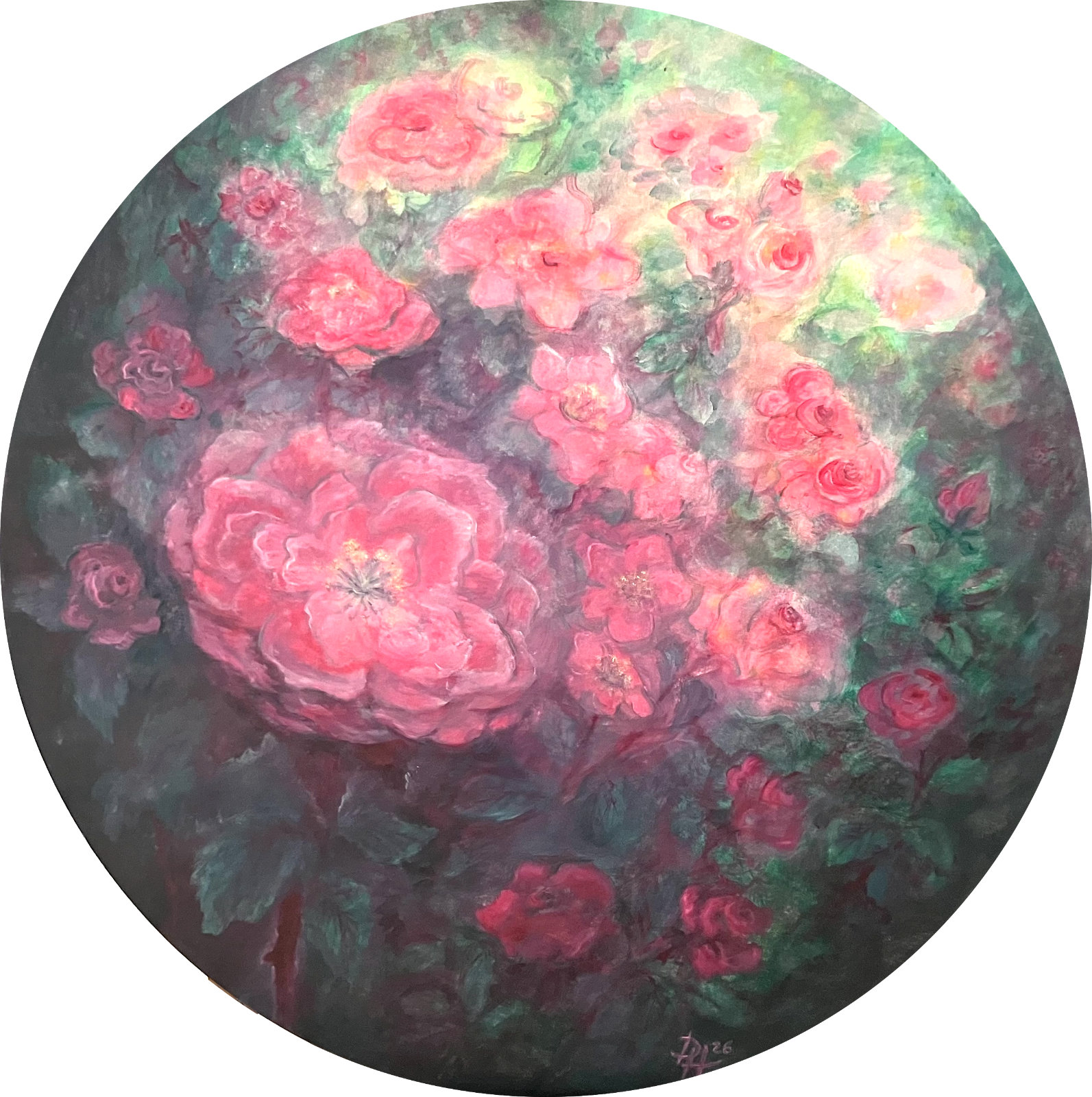
Doris Harpers
Rosa Rosarum
Olio, che si diluisce con l’acqua, su tela
Diametro 90 cm
Anno 2026
Rosa Rosarum
Water-mixable oil on canvas
Diameter 90 cm
Year 2026