


Biografia • Biography
Adriano Foschi è nato a Milano nel 1942 e si è formato alla Scuola Superiore di Pittura dell’Accademia di Belle Arti di Brera. Nel 1964 ha pubblicato il manifesto “Etopatofisica”, una presa di posizione contro l’alienazione della vita urbana. Nel 1970 ha dato vita a “Humandesign”, rivista d’arte con diffusione internazionale. Nella sua lunga e luminosa carriera, l’artista ha sempre saputo cogliere l’unità nel molteplice. Fin dalle primissime opere, la sua arte di avanguardia ha trasceso la fissità dell’icona e della convenzione, ha attraversato con grazia i campi del figurativo e dell’astratto, ha sfatato il mito dell’opera unica valorizzando la riproducibilità tecnica come mezzo di diffusione culturale.
Sia nelle sperimentazioni più ardite che nelle composizioni più canoniche, la sua arte è intrisa di omaggi a maestri di ogni tempo, come Botticelli, Caravaggio, Tintoretto. Del resto, il suo percorso affonda le radici in una secolare tradizione pittorica di famiglia, culminante nel figlio Davide, anch’egli artista visionario e innovatore. Nonostante ciò, Adriano Foschi conserva la sua singolare specificità nel panorama contemporaneo. La sua è un’arte poliglotta, che non si cristallizza in una singola espressione ma sa spaziare nel vasto orizzonte delle possibilità, arrivando a fondere linguaggi apparentemente antitetici, come nel caso dei suoi “alimenti poetici”. Nelle opere degli anni Settanta e Ottanta è la linea a dominare incontrastata, come in uno dei suoi dipinti più celebri, Tensione di equilibrio: un’intersecazione cromatica che squarcia la tela in simmetrie minimalistiche. Un’essenzialità che nelle opere di Adriano Foschi rivela sempre uno slancio verso un Oltre, una dimensione insondabile dove il velo dell’illusione cade assieme ai suoi orpelli materici, e ai nostri occhi si palesa finalmente il Reale nella sua essenza più pura e incontaminata.
Adriano Foschi was born in Milan in 1942, where he studied at the Higher School of Painting of the Brera Academy of Fine Arts. In 1964 he published the manifesto “Etopatofisica” as a denunciation of urban alienation. In 1970 he founded “Humandesign”, an art magazine with international circulation. Throughout his long and distinguished career, the artist has demonstrated an extraordinary ability to discern unity within diversity. From his very earliest works, his avant-garde approach has challenged the static nature of the icon and the constraints of convention, moving effortlessly between the realms of figuration and abstraction. He has also questioned the notion of the artwork as a unique, unrepeatable object, embracing mechanical reproduction as a means of making art more widely accessible and fostering cultural dissemination.
Whether in his boldest experiments or his more traditional compositions, his work is imbued with tributes to great masters across the centuries, including Botticelli, Caravaggio and Tintoretto. Indeed, his artistic journey is deeply rooted in a centuries-old family tradition of painting, carried forward by his son Davide, himself a visionary and innovative artist. Yet Adriano Foschi has always retained a distinctive identity within the contemporary art scene. His is an art that speaks many languages, refusing to be confined to a single mode of expression and instead exploring the boundless possibilities of artistic language, even bringing together seemingly irreconcilable forms, as in his “poetic foods”. In his works of the 1970s and 1980s, line takes centre stage, asserting its presence with remarkable clarity. This is particularly evident in one of his best-known paintings, Tensione di equilibrio (Tension of Equilibrium): here, intersecting lines of colour cut across the canvas and create minimalist geometries. Yet the essential quality of Adriano Foschi’s art always points towards an Elsewhere, an unfathomable dimension in which the veil of illusion falls away, together with its material embellishments, allowing the Real to emerge before our eyes in its purest, most unblemished essence.
Testo critico • Art critique
La tela verticale è attraversata da due sottili diagonali chiare che si incrociano da un angolo all’altro. L’essenzialità minimalista dell’opera, giocata sul contrasto netto tra il fondo scuro e i fasci di luce delle linee, spoglia l’immagine del superfluo. Il piano è totalmente privo di figure: a dominare è solo una X. Il punto in cui le due linee si toccano è anche un punto di sospensione: due direzioni opposte si incontrano e nessuna prevale. L’equilibrio qui non è quiete, è una forza che si regge perché due spinte si contrastano. Allo stesso modo, il dubbio è pensiero tenuto in tensione fra due possibilità.
Il titolo stesso evoca un ossimoro. Una “tensione” è per definizione instabile, dinamica, mossa da forze che tirano in direzioni opposte, mentre l’“equilibrio” rappresenta la stabilità e la pace. Questa dualità riflette la natura stessa del dubbio: uno stato di sospensione interiore in cui la mente oscilla continuamente tra certezze e incertezze, senza trovare un punto di quiete definitivo.
La X è inoltre un segno ambivalente: rappresenta l’incognita, ma anche il punto che segna un luogo nelle mappe. Nega e indica nello stesso gesto: un’ambiguità che appartiene al dubitare.
Il dubbio si configura così non come negazione della certezza, bensì come apertura a ciò che ancora non è stato definito: una soglia conoscitiva dalla quale la realtà rivela la propria complessità e molteplicità.
Angela Patrono
The vertical canvas is crossed by two slender pale diagonals, crossing from one corner to the other. The work’s stark minimalism, built on the clean contrast between a dark ground and the beams of light that are its lines, strips the image of everything superfluous. No figures appear anywhere on the surface: all that remains is an X. The point where the two lines touch is also a point of suspension, where two opposing directions meet and neither gives way. Balance here is not stillness but a force that holds only because two pulls resist each other. Doubt works in the same way: it is thought held in tension between two possibilities.
The title itself is an oxymoron. Tension, by definition, is unstable and restless, driven by forces pulling in opposite directions, while equilibrium stands for steadiness and peace. This duality mirrors the very nature of doubt: an inner suspension in which the mind keeps swinging between certainty and uncertainty, never settling into a final calm.
The X is also an inherently ambiguous symbol: it stands for the unknown, yet it can equally mark a specific location on a map. It both negates and indicates in a single gesture, embodying the ambiguity that lies at the heart of doubt.
Doubt thus emerges not as a rejection of certainty, but as an openness to what has yet to be defined: a threshold of knowledge from which reality reveals its complexity and multiplicity.
Angela Patrono
In mostra • On View
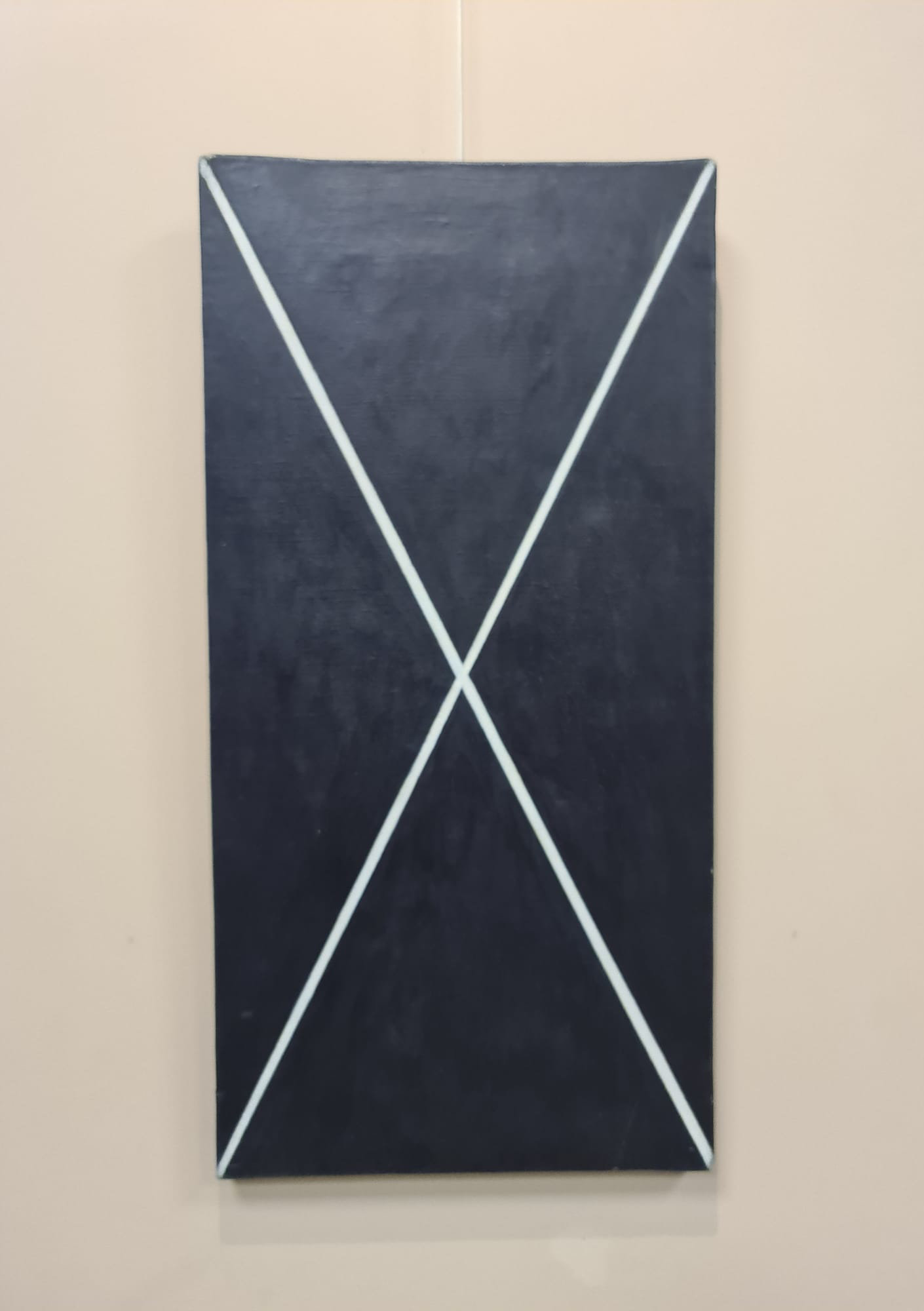
Adriano Foschi
Tensione di equilibrio
Acrilico su tela
60 x 30 cm
Anno 1986
Tension of Equilibrium
Acrylic on canvas
60 x 30 cm
Anno 1986