


Biografia • Biography
Laura Rota nata a Milano il 16/02/1983. Ha conseguito la maturità linguistica nel 2002 presso il Liceo Virgilio di Milano, dopo un’esperienza di convivenza con altri giovani della sua età in un contesto rurale, in un monastero a Montebello della Battaglia Casteggio, si inscrive all’università statale di Milano per il corso di Laurea in storia moderna.
I primi anni di lavoro sono stati nelle ricerche di mercato con un ruolo che è cresciuto nel tempo fino al termine della collaborazione nel 2006. Da allora, nello specifico eventi legati a moda, arte, business è stato il suo impiego. Da 11 anni lavora esclusivamente per la Brunello Cucinelli s.p.a. crescendo con l’azienda.
Laura Rota born in Milan on 16/02/1983. He graduated from high school in 2002 at the Liceo Virgilio in Milan, after an experience of living with other young people of his age in a rural context, in a monastery in Montebello della Battaglia Casteggio, he enrolled at the State University of Milan for the degree course in modern history.
The first years of work were in market research with a role that grew over time until the end of the collaboration in 2006. Since then, specifically events related to fashion, art, business, has been its use. For 11 years he has been working exclusively for Brunello Cucinelli s.p.a., growing with the company.
Testo critico • Art critique
Il titolo Lost Souls, (anime disperse), allarga il significato dell’opera oltre il viaggio fisico. Sono persone perdute le persone che hanno attraversato il mare senza raggiungere la destinazione, sono anime sospese tra due mondi, tra la memoria di ciò che hanno lasciato e l’incertezza di ciò che le attende. L’opera diventa così una dedica a chi ha intrapreso quel viaggio NEL DUBBIO, pagando talvolta il prezzo più alto.
Ogni elemento inserito partecipa a questa narrazione. I frammenti di collage che rivestono i bordi della scatola prolungano all’esterno le cromie e le tensioni della composizione, mentre i fenicotteri continuano oltre la superficie principale, come se la migrazione non potesse essere contenuta entro un limite. In alto, invece, una porzione lasciata scoperta conserva la scritta Handle with care (maneggiare con cura), che è forse uno dei segni più delicati e significativi dell’intero lavoro: un invito a trattare con attenzione ciò che è fragile, instabile, esposto alla possibilità di spezzarsi. Non soltanto i corpi, ma le identità, le speranze e le vite umane.
In Lost Souls, dunque, IL DUBBIO non è una debolezza, ma la condizione stessa dell’esistenza umana. È il punto in cui il desiderio di salvarsi incontra il dolore di lasciare, in cui la speranza si misura con la paura e la promessa del futuro con la nostalgia delle proprie origini. L’opera non offre risposte definitive, perché sa che ogni migrazione contiene una storia diversa tra la terra e la sopravvivenza. Ci chiede, piuttosto, di sospendere il giudizio, di guardare oltre gli stereotipi e di riconoscere, dietro ogni movimento, una persona, una memoria, un mondo intero.
Perché le anime perdute non sono soltanto quelle che scompaiono durante il viaggio. Sono anche quelle che una società smette di vedere. E forse è proprio questo il messaggio più urgente di ‘Lost Souls’: prima di domandarci perché qualcuno parte, dovremmo chiederci che cosa gli impedisce di restare. ED OGGI RIECCOMI QUI!
Federica Cristaudo
The title ‘Lost Souls’, (dispersed souls), broadens the meaning of the work beyond the physical journey. Lost people are people who have crossed the sea without reaching their destination, they are souls suspended between two worlds, between the memory of what they have left behind and the uncertainty of what awaits them. The work thus becomes a dedication to those who have embarked on that journey IN DOUBT, sometimes paying the highest price.
Each element inserted participates in this narrative. The fragments of collage that cover the edges of the box prolong the colors and tensions of the composition outside, while the flamingos continue beyond the main surface, as if the migration could not be contained within a limit. At the top, however, a portion left uncovered retains the inscription Handle with care, which is perhaps one of the most delicate and significant signs of the entire work: an invitation to treat carefully what is fragile, unstable, exposed to the possibility of breaking. Not only bodies, but identities, hopes and human lives.
In Lost Souls, therefore, DOUBT is not a weakness, but the very condition of human existence. It is the point at which the desire to save oneself meets the pain of leaving, where hope is measured by fear and the promise of the future by nostalgia for one’s origins. The work does not offer definitive answers, because it knows that every migration contains a different story between the land and survival. Rather, it asks us to suspend judgment, to look beyond stereotypes and to recognize, behind every movement, a person, a memory, an entire world. Because lost souls are not only those who disappear during the journey. They are also those that a society stops seeing.
And perhaps this is precisely the most urgent message of ‘Lost Souls’: before asking ourselves why someone leaves, we should ask ourselves what prevents them from staying. AND TODAY HERE I AM AGAIN!
Federica Cristaudo
In mostra • On View
Laura Rota
Lost SOULS
Collage acquerellato
Lost SOULS
Watercolor collage
Descrizione • Description
LOST SOULS — Il dubbio di partire, la fragilità del restare
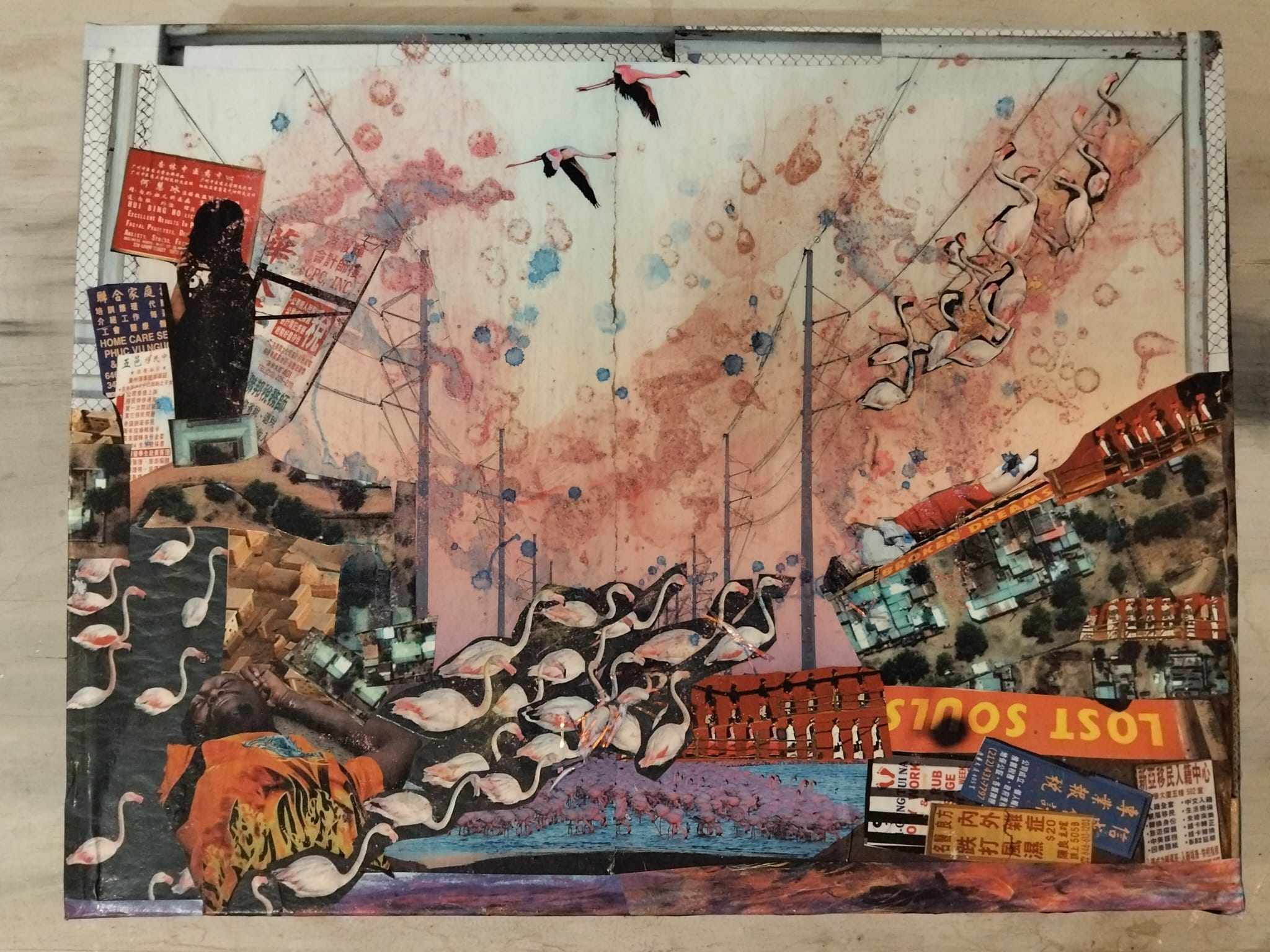
‘Lost Souls‘ è un’opera che dà voce a una delle contraddizioni più profonde del nostro tempo: il dubbio tra restare e partire, tra la sicurezza delle proprie radici e la speranza di una vita altrove. È un collage che non si limita a rappresentare la migrazione, ma ne mette in scena il conflitto umano, politico e ambientale, trasformando la superficie dell’opera in un territorio ferito, attraversato da confini, promesse e possibilità negate.
Al centro di questa riflessione si trova una differenza essenziale: gli animali migrano per istinto, l’essere umano è costretto ad interrogarsi sulla scelta.
Ma anche le rotte naturali, oggi, vacillano. Gli uccelli cambiano traiettorie, gli habitat si trasformano, i luoghi familiari diventano irriconoscibili.
Il viaggio diventa incerto. E per l’uomo IL DUBBIO assume un peso ancora più drammatico: partire significa abbandonare la propria terra, la madre, gli affetti, i paesaggi e quei tramonti che nessun altro luogo potrà restituire nella stessa forma. Le reti che circondano la composizione evocano una gabbia simbolica: l’Africa appare come uno spazio insieme vitale e imprigionato, un luogo dal quale si desidera fuggire, ma nel quale si vorrebbe anche poter restare. I pali e le strutture attraversano la scena come segni di controllo, mentre le file di uomini, disposte quasi meccanicamente, sembrano perdere la propria individualità, diventando corpi in movimento, presenze seriali, vite ridotte a una direzione obbligata.
È un’umanità che avanza, ma della quale non sempre vediamo il volto.
In netto contrasto con questa marcia compare la figura dell’uomo disteso, apparentemente sereno, la sua presenza introduce una domanda silenziosa: che cosa significa davvero avere una vita migliore? Quell’uomo sembra ricordarci che la felicità non coincide necessariamente con il possesso, ma può risiedere nell’appartenenza, nella possibilità di vivere la propria terra senza doverla abbandonare. Il collage apre così una riflessione anche sui rapporti di potere che accompagnano lo sviluppo economico. I cartelli di origine cinese e la sagoma nera dell’uomo cinese introducono la presenza delle grandi potenze e degli investimenti infrastrutturali. E mentre lo sguardo cerca risposte, i fenicotteri attraversano l’opera come una presenza fragile e insistente.
Il loro volo richiama la migrazione naturale, ma anche la bellezza di una libertà che non conosce frontiere politiche. Il riferimento visivo a Gli uccelli di Alfred Hitchcock introduce una nota inquieta: ciò che dovrebbe essere familiare può trasformarsi improvvisamente in qualcosa di minaccioso. Gli uccelli non sono più soltanto simboli di libertà, ma presenze capaci di incrinare la percezione della sicurezza.
La natura stessa sembra partecipare all’instabilità del presente.
Federica Cristaudo
LOST SOULS — The doubt of leaving, the fragility of staying
‘Lost Souls’ is a work that gives voice to one of the deepest contradictions of our time: the doubt between staying and leaving, between the security of one’s roots and the hope of a life elsewhere. It is a collage that does not limit itself to representing migration, but stages its human, political and environmental conflict, transforming the surface of the work into a wounded territory, crossed by borders, promises and denied possibilities.
At the center of this reflection is an essential difference: animals migrate by instinct, human beings are forced to question their choice. But even natural routes are faltering today. Birds change trajectories, habitats are transformed, familiar places become unrecognizable.
The journey becomes uncertain. And for man DOUBT takes on an even more dramatic weight: leaving means abandoning one’s land, one’s mother, loved ones, landscapes and those sunsets that no other place can restore in the same form. The nets that surround the composition evoke a symbolic cage: Africa appears as a space that is both vital and imprisoned, a place from which one wishes to escape, but in which one would also like to be able to stay. The poles and structures cross the scene as signs of control, while the rows of men, arranged almost mechanically, seem to lose their individuality, becoming bodies in motion, serial presences, lives reduced to an obligatory direction.
It is a humanity that advances, but whose face we do not always see. In stark contrast to this march appears the figure of the man lying down, apparently serene, his presence introduces a silent question: what does it really mean to have a better life? That man seems to remind us that happiness does not necessarily coincide with possession, but can reside in belonging, in the possibility of living one’s land without having to abandon it. The collage thus also opens a reflection on the power relations that accompany economic development. The signs of Chinese origin and the black silhouette of the Chinese man introduce the presence of the great powers and infrastructure investments. And while the gaze seeks answers, the flamingos cross the work like a fragile and insistent presence. Their flight recalls natural migration, but also the beauty of a freedom that knows no political borders.
The visual reference to Alfred Hitchcock’s The Birds introduces an uneasy note: what should be familiar can suddenly turn into something threatening. Birds are no longer just symbols of freedom, but presences capable of cracking the perception of security.
Nature itself seems to participate in the instability of the present.
Federica Cristaudo